

The 10 Best SocialPilot Alternatives in 2026

SocialPilot is a capable, agency-friendly scheduler, and it’s genuinely good at the thing it’s built for: pushing a lot of content through a lot of accounts without much fuss. If you’re looking at alternatives, it’s usually for a more visual planning experience, a simpler interface, or a different shape of pricing.
This is an honest look at the best SocialPilot alternatives in 2026. We lead with Hopper HQ because it’s what we make, and we’ll be clear about where it wins and where another tool is the better call. SocialPilot itself remains a solid choice for agency bulk work, and we’ll say so.
One thing worth settling before you read on: switching tools only pays off if you know what you’re switching for. “Something nicer” is hard to shop for. “A calendar my team will actually open, and Stories that publish without anyone remembering” is a decision you can make in an afternoon.
Start your free 14-day trial →
What SocialPilot is genuinely good at
SocialPilot built its reputation on volume. Bulk scheduling, client management, group-level publishing, and support for a lot of connected accounts at a price that works when you’re managing dozens of them. For an agency with fifteen clients and a content calendar to fill, that’s exactly the right set of priorities.
That focus is a design choice rather than a gap. It optimizes for throughput, and throughput is what an agency sells. If your week is “get 200 posts scheduled across 15 accounts by Friday”, SocialPilot does that job well and there may be no reason to move.
Where people tend to outgrow it is the planning experience itself: how visual it is, how much you enjoy using it daily, and how reliably it publishes formats like Reels and Stories without anyone stepping in. That’s usually what sends them looking.
Why people actually leave SocialPilot
In our experience there are four reasons, and they rarely arrive alone.
Throughput stopped being the whole job. Getting content out is one thing. Making it look considered is another. Once clients start judging the feed as a whole rather than the individual post, a tool built around bulk uploading starts to feel like the wrong instrument.
Nobody enjoys opening it. This sounds soft and it isn’t. A tool your team avoids becomes a tool your team works around, and workarounds are where mistakes live. Daily pleasantness is a real feature when three people share the same calendar.
Reminders stopped being acceptable. A notification telling someone to go and post a Story manually is fine once. It’s not fine across 15 client accounts on a Friday evening.
The bill stopped matching the shape of the business. Tiered pricing bundles accounts into brackets. Winning one new client can mean paying for a whole bracket you didn’t need, which is an odd way to be punished for growth.
If none of those describe you, save yourself the migration. If two or more do, keep reading.
How we compared these tools
We’re the makers of one of the tools on this list, so here’s how we’ve tried to keep this useful rather than self-serving.
We compare on things that don’t change every quarter: whether a tool plans visually, whether it publishes on its own, which networks it covers, how it handles clients and approvals, how deep its reporting goes, and how its pricing is shaped. We deliberately don’t list prices. They move constantly, and a comparison table full of out-of-date numbers is worse than no table at all. Check each tool’s pricing page for current figures before you commit.
We also say plainly where another tool beats us. If you need enterprise social listening or a fully white-labeled client dashboard, we’ll point you at the platforms built for that rather than pretend simplicity covers everything.
What to look for in a SocialPilot alternative
Work out which of these actually matter to you before comparing. Most agencies need four of the six, and paying for all six is how you end up with a dashboard nobody opens.
Visual planning. A drag-and-drop calendar, and a grid preview you can trust before anything goes live. This is the single biggest difference between a volume-led tool and a feed-led one, and it’s usually what people miss when they’ve been living in a bulk uploader.
True auto-publishing. Posts, Reels, and Stories that publish automatically rather than sending someone a phone reminder. Worth checking format by format and network by network, because support varies more than marketing pages suggest.
Client management. Workspaces, approvals, roles, and client access. Ask specifically whether clients can see and approve without a paid seat of their own, because that detail changes the price a lot.
White-labeling. Whether reports and dashboards can carry your branding, and what it costs. This is frequently an add-on or a higher tier rather than something included, so price the configuration you’d actually buy.
Channel coverage. The networks your clients actually use, including short-form video. Count the ones you post to weekly, not the ones a client mentioned once.
Pricing model. Flat tiers, per-seat, or per-account, and whether key features sit behind higher plans. Two tools at the same headline price can differ enormously once you add a second brand or a third teammate.
SocialPilot alternatives at a glance
| Tool | Best for | What stands out |
|---|---|---|
| Hopper HQ | Simple, visual planning | Grid preview, auto-publishing, no feature gating |
| Sendible | Agency client management | Client workspaces, optional white-label dashboard |
| Agorapulse | Engagement and inbox | Unified social inbox, on per-user pricing |
| Later | Instagram-first planning | Visual calendar and link-in-bio |
| Buffer | Simple, clean scheduling | Approachable queues and Start Page |
| Metricool | Analytics and ads together | Reporting plus ad management |
| Loomly | Guided content planning | Post ideas and approval workflows |
| Hootsuite | Enterprise monitoring | Monitoring streams and team workflows |
| Sprout Social | Premium analytics | Custom reports, with listening as an add-on |
| Zoho Social | Zoho ecosystem users | Ties into the wider Zoho suite |
Pricing note: this guide compares on durable features rather than prices, which change often. Check each tool’s pricing page for current numbers.
The 10 best SocialPilot alternatives
1. Hopper HQ, best for simple, visual planning
Where SocialPilot optimizes for volume, Hopper HQ optimizes for the feed. You plan how it will look, not just how much of it there is.
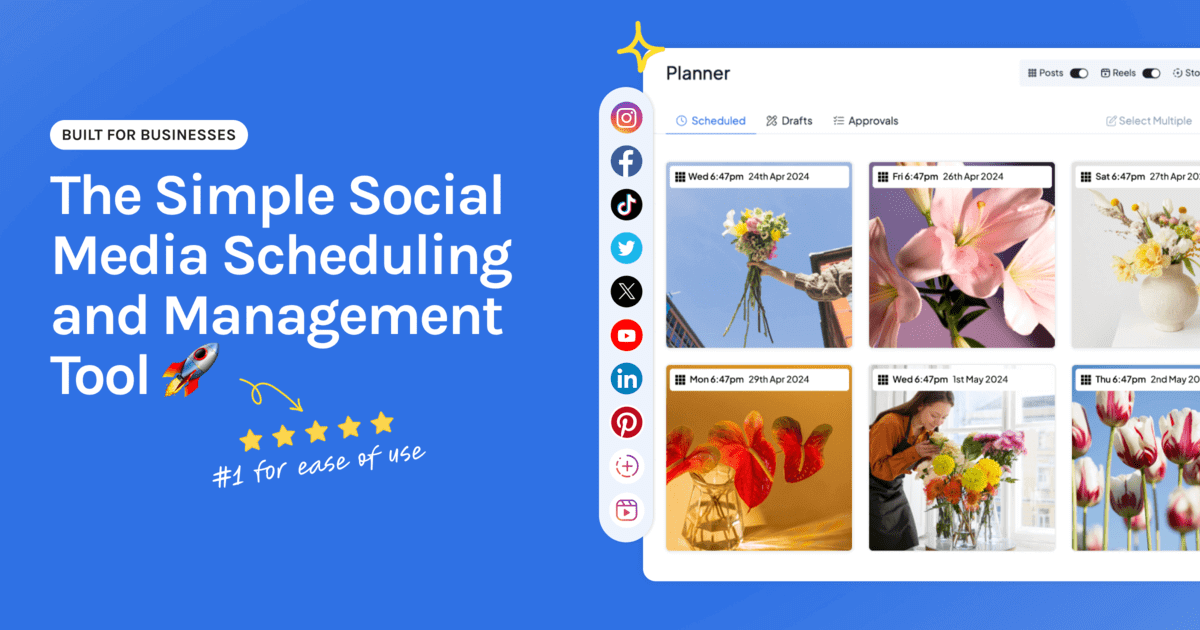
Key features: drag-and-drop calendar, a grid preview you can trust, bulk upload, true auto-publishing for posts, Reels and Stories across every major network from one calendar, a link-in-bio tool, hashtag explorer, an AI assistant and saved captions, plus iOS and Android apps.
Best for: small business owners, creators, and lean agencies who want visual planning with approvals included, not a volume dashboard.
Pricing model: per account, so a new client adds a line rather than pushing you up a tier.
Hopper HQ vs SocialPilot: SocialPilot goes further on high-volume agency tooling and group publishing. Hopper HQ is visual-first, publishes Reels and Stories for you, and doesn’t gate analytics, link-in-bio, hashtags, or AI behind a higher tier. Content approvals and team permissions come with the team plan.
Watch for: if you need a fully white-labeled client dashboard or enterprise social listening, the agency-focused and premium suites go further.
The honest summary: if you’re an agency whose clients judge the grid, planning visually and letting it publish itself is worth more than another bulk uploader. If your value is pushing serious volume through many accounts, SocialPilot is built for that and we won’t pretend otherwise.
2. Sendible, best for agency client management
Sendible is built around the agency-client relationship rather than the post.
Key features: client workspaces and dashboards, approval workflows, broad integrations, scheduling and reporting. A fully white-labeled dashboard is available as a paid add-on on eligible higher plans.
Best for: agencies that need each client in their own space, with reporting that can carry your branding.
Sendible vs SocialPilot: Sendible leans harder into client separation and white-labeling, where SocialPilot leans into volume at a lower price point.
Watch for: full white-labeling is an add-on rather than standard, so price the tier you’d genuinely need.
This is the pick when your clients log in themselves and the experience needs to look like yours. If they only ever see a PDF, you’re paying for something you won’t use.
3. Agorapulse, best for engagement and inbox
Agorapulse is built around conversations, pulling messages, comments, and mentions into one place.
Key features: unified social inbox, engagement workflows, team collaboration and approvals, reporting with branded reporting options, and competitor tracking.
Best for: teams handling a high volume of comments and messages every day.
Agorapulse vs SocialPilot: the inbox is the reason to move. SocialPilot is publishing-led, Agorapulse is engagement-led.
Watch for: it’s priced per user, so the advantage depends entirely on your seat count. Do the math at the team size you’ll actually have.
Community management as the main job makes this an easy call. If nobody on your team spends their morning in the inbox, you’d be paying for the wrong strength.
4. Later, best for Instagram-first planning
Later helped define visual Instagram planning, and its link-in-bio tool is one of the best known in the category.
Key features: visual content calendar, media library, best-time-to-post suggestions, hashtag tools, and a well-known link-in-bio product, with support for the major networks.
Best for: creators and brands whose main channel is Instagram.
Later vs SocialPilot: far more visual, and stronger on Instagram specifically, where SocialPilot is built for breadth and volume.
Watch for: post limits and pricing can bite as you scale across many client accounts.
Later and Hopper HQ are the closest comparison here, because both start from the feed rather than the queue. The question is usually breadth. See Later alternatives.
5. Buffer, best for simple, clean scheduling
Buffer built its reputation on being uncluttered and quick to learn.
Key features: clean publishing queues, a drag-and-drop calendar, the Start Page link-in-bio tool, an engagement inbox, and reporting through the newer Buffer Insights product.
Best for: small teams who want straightforward scheduling without a learning curve.
Buffer vs SocialPilot: Buffer is simpler and more polished for a few accounts, where SocialPilot handles many accounts far better.
Watch for: it’s text-led rather than visual, and agency client management isn’t its focus.
Buffer is a step sideways rather than up if you’re an agency. It suits the in-house team of two who found SocialPilot heavier than they needed. See Buffer alternatives.
6. Metricool, best for analytics and ads together
Metricool is an analytics-led all-in-one that folds scheduling, reporting, and ad management into one place.
Key features: cross-network analytics, competitor tracking, scheduling, ad campaign management, and a link-in-bio tool.
Best for: teams running organic and paid together who are tired of two tabs.
Metricool vs SocialPilot: Metricool goes deeper on reporting and ads, where SocialPilot is stronger on publishing volume.
Watch for: the planning experience is less visual than a dedicated planner.
If your agency bills for ad management as well as organic, this consolidates two jobs. If nobody touches ad spend, most of what you’d pay for goes unused.
7. Loomly, best for guided content planning
Loomly is calendar-first and leans into helping you decide what to post.
Key features: content calendar, post ideas and optimization tips, post previews, approval workflows, an asset library, and campaign labels with UTM tracking.
Best for: teams that want structure and sign-off around their content.
Loomly vs SocialPilot: Loomly adds content guidance and layered approvals, where SocialPilot is quicker for pure scheduling throughput.
Watch for: it’s scheduling-centric, and its inbox tools are less extensive than Sprout’s Smart Inbox rather than absent.
Loomly suits the agency whose bottleneck isn’t publishing, it’s deciding and agreeing. If you’ve ever lost two days waiting for a client to approve a caption, that’s the problem it solves.
8. Hootsuite, best for enterprise monitoring
Hootsuite is one of the oldest, broadest suites, built for larger organizations.
Key features: wide channel support, monitoring streams, bulk scheduling, team roles and approvals, and an inbox, with advanced listening available depending on the plan or product package.
Best for: bigger teams that need monitoring and workflows across many accounts.
Hootsuite vs SocialPilot: Hootsuite goes further on monitoring and enterprise workflow, at a considerably higher price and with more complexity.
Watch for: cost and complexity are the two things small agencies consistently regret here. Listening depth varies by plan and package.
Most teams leaving SocialPilot are looking for something lighter, not heavier. Hootsuite is the answer only if you’re scaling up rather than simplifying. See Hootsuite alternatives.
9. Sprout Social, best for premium analytics
Sprout Social is a premium platform with strong native analytics and reporting, aimed at larger teams with the budget to match.
Key features: Smart Inbox, comprehensive native analytics and reporting, team workflows and approvals, and contact management, with more advanced listening and premium analytics available as additional products.
Best for: teams where reporting is central and someone genuinely reads it.
Sprout Social vs SocialPilot: an enormous step up in reporting depth, at a price that only makes sense once reporting is part of somebody’s job.
Watch for: listening and premium analytics are separate products rather than included.
If you’re leaving SocialPilot on price, this is the wrong direction. It’s the right answer when a client’s reporting requirements have outgrown what you can produce. See Sprout Social alternatives.
10. Zoho Social, best for Zoho ecosystem users
Zoho Social is a competent scheduler whose real advantage is what it sits next to.
Key features: scheduling and calendar, monitoring, team collaboration and approvals, reporting, and tight integration with Zoho CRM and the wider Zoho suite.
Best for: businesses already running on Zoho.
Zoho Social vs SocialPilot: the integration is the whole argument. On social features alone the two are closer than the price difference suggests.
Watch for: if you don’t use Zoho elsewhere, the main reason to pick it disappears.
Straightforward call: already on Zoho, worth a look. Not on Zoho, look elsewhere first.
How to switch from SocialPilot without dropping a client
Reconnecting accounts is quick. The agency-specific parts are what take time, so do them in this order.
Export your queues before you cancel. Published posts stay on the networks, so nothing live is at risk. Queued and drafted content is the exposure, especially if you schedule months ahead. Get it out first.
Move one client, not all of them. Pick your most forgiving account, run a full week through the new tool, and only then migrate the rest. A staged switch turns a risky weekend into a quiet fortnight.
Rebuild approvals before you rebuild content. Get roles, permissions, and client access working while the stakes are low. Discovering that a client can’t approve anything on the morning of a campaign is a bad day.
Bulk upload a month before you judge it. A tool feels completely different holding four weeks of real client content instead of two test posts.
Questions to ask before you commit
Use the trial for these, because marketing pages won’t answer them.
Does it publish Reels and Stories on its own, for every account you connect? Ask format by format, not “Instagram support” in general.
Can a client approve a post without a paid seat? This single answer can change the total cost more than the headline price does.
What happens when you add your next client? Watch whether the price steps up a bracket or scales with what you added.
What does white-labeled reporting actually include, and at which tier? “Branded reports” and “white-label dashboard” are different products at different prices.
How to choose
- Visual planning with approvals included? Hopper HQ.
- Client workspaces and white-label dashboards? Sendible.
- The inbox is the job? Agorapulse.
- Instagram-first with link-in-bio? Later.
- Simple queues for a small in-house team? Buffer.
- Organic and paid in one place? Metricool.
- Help deciding what to post? Loomly.
- Enterprise monitoring across many accounts? Hootsuite.
- Reporting that stands up in a board pack? Sprout Social.
- Already running on Zoho? Zoho Social.
- Happy with agency bulk tools at a team price? SocialPilot may already be right.
The short version
SocialPilot is built for volume, and volume is a real problem worth solving. If that’s your bottleneck, stay. If your bottleneck is that the work doesn’t look as considered as it should, or that publishing still needs a human on a Friday night, a feed-led tool will serve you better.
If the answer is “I want visual planning across every network, with approvals included and Stories that publish themselves”, that’s what we built. Compare the whole field in our best social media scheduler guide, or schedule every network from one calendar. Try it free for 14 days and see whether it saves you the afternoon it promises.
Frequently asked questions
What is the best SocialPilot alternative?
It depends what you're switching for. If you want simpler, more visual planning with a grid preview and true auto-publishing for Reels and Stories, Hopper HQ is built for that. If you need agency client workspaces look at Sendible, for heavy engagement look at Agorapulse, and if reporting is central look at Sprout Social, bearing in mind that its more advanced listening and premium analytics are separate products.
What is SocialPilot best at?
SocialPilot has a strong reputation with agencies for bulk scheduling, client management, and handling a lot of accounts at a team-friendly price. If those are your priorities and it's working, it's a capable tool and there may be no reason to move.
Why do people switch from SocialPilot?
The most common reasons are wanting a more visual planning experience, a simpler interface, or hands-off auto-publishing for Reels and Stories rather than reminders. Volume tools optimize for throughput, and some teams find they've traded away the part they enjoy.
Is there a free SocialPilot alternative?
Several tools offer limited free plans, and most, Hopper HQ included, offer a free trial so you can test the full workflow before you pay. Free tiers in this category usually cap connected accounts and scheduled posts, which are the two things an agency needs most, so check the current limits on each pricing page.
Which SocialPilot alternative is best for agencies?
Sendible offers client workspaces and an optional fully white-labeled dashboard on eligible higher plans. Agorapulse provides team inbox, reporting, and collaboration features including branded reporting options, though it charges per user. Hopper HQ suits lean agencies that want simple visual planning with content approvals and team permissions included on the team plan.
Which SocialPilot alternative is best for Instagram?
Hopper HQ and Later both lean into Instagram-first visual planning with a grid preview. Hopper HQ extends that visual approach across every major network from one calendar, while Later is strongest when Instagram and link-in-bio are your main focus.
Do I have to pay for a whole new plan tier just to add one client?
That depends on the pricing model, and it's worth checking carefully if you're an agency. Tiered tools bundle a set number of accounts per plan, so one new client can push you up a whole tier. Hopper HQ prices per account instead, so you add the accounts you need without buying a bracket you don't.
Will I lose my scheduled posts if I switch?
Your published posts stay on the networks themselves, so nothing already live is affected. Anything still sitting in a queue is worth exporting before you cancel, because queued drafts don't transfer between tools automatically. If you bulk schedule months ahead, this is the part to plan for.
How long does it take to move an agency off SocialPilot?
Reconnecting accounts takes minutes each, so the real work is rebuilding queues and re-establishing client approvals. Plan a day if you manage many clients, an afternoon if you have a handful. Moving one client first, rather than all of them at once, makes the switch far less stressful.
Take your social game further with Hopper HQ.
Plan, schedule and auto-post to every channel in one place. Free for 14 days · Cancel anytime.